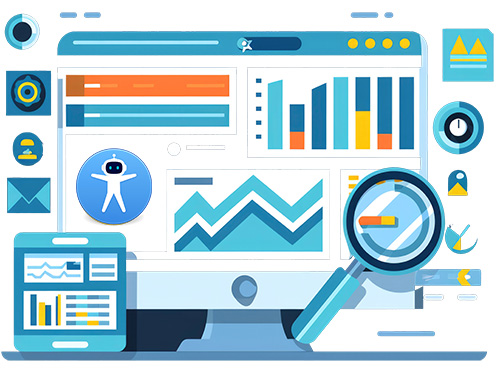
Traditional website performance monitoring relies on manual checks and threshold-based alerts. Efficient but labor-intensive. AI promises more intelligent monitoring, faster alerts, and fewer late-night emergencies, changing how we think about keeping websites fast, available, and reliable. AI-powered monitoring promises to make your life easier. But like any new technology, it comes with trade-offs. Understanding the pros and cons, and how AI stacks up against old-school, tried-and-true manual approaches, can help you decide whether AI is a must-have, a nice-to-have, or just another thing for you to keep an eye on.
Let’s start by looking at traditional website monitoring tasks and how AI can reduce manual workload.
Traditional Website Monitoring
Traditional website performance and uptime monitoring used to be a hands-on job that included setting up monitoring tools, configuring alerts, running scripts, and checking logs. You would tell the system to monitor metrics like uptime, response time, CPU usage, and error rates, and it would alert you when anything crossed a threshold.
Again, the method is effective, but it also has limitations. You have to anticipate issues in advance to configure your monitoring accordingly. Alerts can be vague and lack enough context to get a clear picture of what is wrong and what needs correcting. Identifying root causes requires time-consuming log analysis, and any helpful insights still depend on someone connecting data points. As a result, this approach is reliable but largely reactive. Issues are typically discovered only after a failure occurs.
How AI Creates a Proactive Approach
AI can monitor and learn what your website's typical activity looks like over time. Then, instead of relying on static thresholds, it can continuously analyze patterns across performance metrics, traffic fluctuations, error rates, and user behavior. When something deviates from those patterns, even if nothing has technically failed yet, AI can surface the issue early, allowing you to respond before users ever notice.
Is AI Monitoring the Right Fit for Your Website?
To help you answer this question, let's dig a little deeper and look at the pros and cons of using AI to monitor your website’s performance and uptime:
The Pros:
First, AI enables proactive issue resolution, spotting patterns that often lead to outages and warning you before something breaks.
AI also helps reduce false alarms by learning what normal activity looks like on your site, enabling it to better distinguish a real problem from harmless noise.
AI can also provide you with deeper insights. By analyzing performance data alongside user behavior, such as how they navigate your website, AI identifies opportunities to improve speed and usability.
AI supports automated, intelligent responses, such as load balancing and service restarts.
And finally, AI can markedly reduce the amount of manual work required. Once configured, AI monitoring requires less constant oversight, providing more time for actual improvements. And, as your site grows, AI will scale along with it.
Taken together, these capabilities can lead to a better user experience, higher overall uptime, and, in the longrun, lower operational costs.
But don't jump onboard just yet. There are several disadvantages to implementing AI for website monitoring that are certainly worth noting.
The Cons
While AI can help make website monitoring smarter, it’s not without drawbacks. One primary concern is the black-box problem: when AI flags an issue, but you don’t have access to the reason why, it makes troubleshooting difficult and likely time-consuming.
AI can struggle with complex, dynamic pages, particularly those heavy in JavaScript, leading to incomplete or misleading insights and algorithmic biases that skew results and yield incorrect performance conclusions.
Poorly trained AI can result in unnecessary alerts while simultaneously missing real issues that require your attention. Plus, AI systems are vulnerable to adversarial attacks, in which malicious actors manipulate the system through prompt injection or data poisoning.
Finally, over-reliance on AI can be risky. Human insight remains essential for spotting subtle trends, responding to real-time changes, and identifying issues an algorithm might overlook.
Is There a Sweet Spot?
AI can work well for you when it has well-defined guardrails, policies, procedures, and guidelines, along with rollback plans. It must be well-trained, well-governed, and work as a teammate rather than a replacement, complementing human insight with speed and automation.
Resources
- 5 Advantages of Using AI in Performance Testing
- The Impact of AI on Website Performance and Speed
- AI Monitoring for Hosting Uptime: From Reactive Support to Predictive Stability
- Self-Healing Hosting: How AI is Changing Web Uptime Management Forever
- Harnessing the power of AI in uptime monitoring for predictive analysis
A human author creates the DubBlog posts. The AI tools Gemini and ChatGPT are sometimes used to brainstorm subject ideas, generate blog post outlines, and rephrase certain portions of the content. Our marketing team carefully reviews all final drafts for accuracy and authenticity. The opinions and perspectives expressed remain the sole responsibility of the human author.
