How Acquiring Accessibility Expertise Changes What You See
Years ago, while working in higher education, I came across a concept called the Magic Escalator of Acquired Knowledge. I don’t remember exactly where or when I found it, but I do remember thinking something like, That’s it. That’s how I’m going to approach this. I’m getting on that escalator and taking it one step at a time.
I printed the image and taped it to the giant whiteboard in my office, where I was mapping out a digital accessibility program. I kept that image as a way to think about my own accessibility journey - where my knowledge was at any given time, what I still needed to learn, and, most importantly, where I wanted to go next.
What Is the Magic Escalator of Acquired Knowledge?
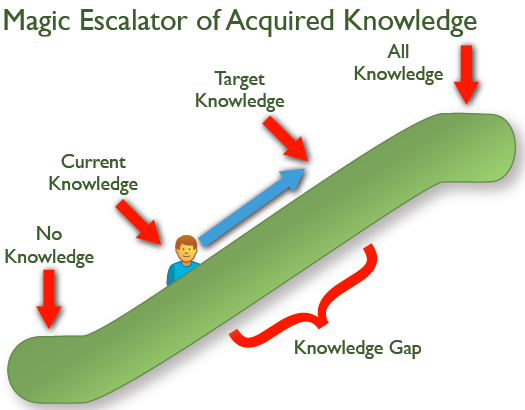
The concept, developed by Jared Spool, describes how our existing knowledge shapes what we can understand and accomplish. As our knowledge grows, we start to see patterns, connections, and problems that weren't visible to us before.
But that knowledge doesn't come to us all at once. We acquire it through experience, training, practice, observation, and sharing what we've learned with others.
That idea maps surprisingly well to learning digital accessibility.
When you're new to accessibility, you start with the rules:
- Learn WCAG.
- Check color contrast.
- Add ALT text.
- Make your website keyboard-accessible.
Those things matter. They're foundational. But eventually, something changes.
You start seeing accessibility differently.
You notice that a form can technically pass an automated check and still be confusing. You recognize that a link can technically work while providing almost no useful context. You realize that an error message can exist without actually helping someone understand or fix the problem.
That's the escalator at work.
As your knowledge grows, you're not just learning more accessibility rules. You're seeing more of the experience.
From Checking Requirements to Understanding People
A lot has been written about the importance of including automated testing in the overall accessibility auditing and monitoring process. Automated tools can quickly identify many common issues and help practitioners find problems at scale.
But tools don't understand everything about the user’s experience.
They don't know whether the instructions make sense. They can't fully evaluate intent or context. And they can't tell you what it's like for a person using a screen reader to navigate a complicated application process.
That's where human evaluation and acquired knowledge come in.
The more you understand accessibility, the more you begin to ask questions that go beyond Does this meet the requirement?
You start asking:
- Can someone find what they need?
- Can they understand what they're supposed to do?
- Can they complete the task?
- Does the experience make sense?
- What happens when the content changes?
- How would someone using assistive technology experience this?
Your questions become more nuanced as you acquire a deeper, broader view of the user experience.
The Escalator Never Stops
Accessibility knowledge isn't something you suddenly acquire, and then you’re done. You acquire it through training, practice, observation, knowledge sharing, experience, and a better understanding of how people use technology.
The Magic Escalator of Acquired Knowledge reminds us that accessibility expertise isn't gained through memorizing guidelines alone. Practitioners need opportunities to develop and share skills, context, experience, and lessons learned.
Each new encounter offers a new perspective on how people make sense of their digital world. What begins as learning rules and guidelines eventually becomes an understanding of people and their needs, behaviors, and how they navigate digital experiences.
The more steps we take, the better equipped we are to create experiences people can use successfully, regardless of ability, circumstance, or technology.
Resources
- The Magic Escalator of Acquired Knowledge — Center Centre
- W3C Web Accessibility Initiative: Accessibility Fundamentals
A human author creates the DubBlog posts. The AI tools Gemini and ChatGPT are sometimes used to brainstorm subject ideas, generate blog post outlines, and rephrase certain portions of the content. Our marketing team carefully reviews all final drafts for accuracy and authenticity. The opinions and perspectives expressed remain the sole responsibility of the human author.
