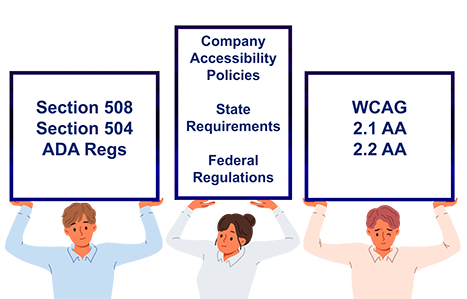
At the recent Virginia Higher Education Accessibility Partners (VHEAP) conference in May, our sales executive, Luke Bachelor, had an interesting conversation with one of the attendees.
They described a challenge that many higher education institutions face. Their accessibility policies require departments to purchase or renew only accessible technology whenever possible. It's a goal rooted in good practice, accountability, and a commitment to inclusion. On paper, that sounds straightforward and what many of us advocate for.
In practice, that policy may create its own set of barriers.
Some software applications are so deeply embedded in an institution's operations that replacing them is just not a realistic option, even when significant accessibility issues are baked into the software.
The example shared at VHEAP is an industry-standard application that students are expected to learn before entering the workforce. Faculty are required to teach it because employers expect graduates to know how to use it. Yet the software itself has known accessibility issues.
The institution can’t simply stop teaching it. It also can’t ignore its accessibility obligations. So does this make a case for the institution to assert an undue burden or fundamental alteration exception?
That’s a difficult question to answer.
When a technology is essential to an institution's mission, has no viable equivalent alternative, and cannot be replaced without significant disruption, does that create an exception? Is this the kind of situation the concept of undue burden or fundamental alteration was designed to address?
To help answer those questions, let’s take a look at what undue burden or fundamental alteration means, how it is determined, and the next steps an organization would take to meet that exception.
Before we get started, please note. The following should not be interpreted as legal advice. It is intended solely as a plain-language overview of the concept of undue burden or fundamental alteration in digital accessibility, along with links to additional resources for further reading. Please consult your qualified legal counsel before asserting an undue burden or fundamental alteration exception.
What is Undue Burden or Fundamental Alteration?
Undue Burden - When determining whether conformance to requirements in the Revised 508 Standards would create an undue burden, the key question would be whether meeting those requirements would involve significant difficulty or cost when compared to the agency resources available to the program or component for which the ICT is to be procured, developed, maintained, or used.
In other words, if the cost or level of effort required to meet the Revised 508 Standard is disproportionate to the resources available to the organization or program supporting the Information and Communication Technology, ICT, the agency may determine that compliance would impose an undue burden.
Fundamental Alteration - A fundamental alteration is a change that would alter the function or purpose of the technology itself. For example:
- Requiring a speech-to-text application to provide all information exclusively through visual text, with no speech processing, would eliminate its core function.
- a software program which needs to be in a certain industry standard file format, and that format can’t support accessibility. If conversion to an accessible alternative format results in incompatibility with the software program, using a different file format could be considered a fundamental alteration. ~ Understanding Section 508 Exceptions
In other words, if making a change to an ICT would remove or substantially change the core function of that technology, a fundamental alteration exception may exist.
Basis for Determination
To determine whether an organization can assert an undue burden or fundamental alteration exception, an agency expert such as an accessibility program manager, IT compliance analyst, accessibility engineer, or solutions architect, should evaluate and document the extent to which conformance would require significant cost or level of effort, based on available resources, including budget, staffing, expertise and time, within the business unit or function for which the ICT is to be procured, developed, maintained, or used.
Required Documentation
In preparing the basis for determination, records and documentation should clearly outline why compliance would be costly and require significant effort, as well as the extent to which it would impose an undue burden or fundamentally alter the nature of the ICT itself.
Note: The Revised 508 Standards do not specify the documentation needed to justify Undue Burden or Fundamental Alteration, an approval process, nor how the agency should record a determination of Undue Burden or Fundamental Alteration. ~ Understanding Section 508 Exceptions
But based on information and guidance from the U.S. Access Board and GSA Section 508, Determine ICT Exceptions, one can compile a list of documentation items that may help create a business case for an exception and build a documented rationale tied to cost, resources, and impact. Some of those items include:
Scope of ICT
- What system, tool, or content is affected.
- Where it is used and by whom.
Accessibility Requirements Affected
- Which WCAG / 508 criteria are not met.
- Why are they not currently achievable.
Resource Analysis
- Cost estimates - development, licensing, remediation.
- Staff availability / expertise.
- Time constraints - procurement deadlines, deployment schedules.
Impact Assessment
- What would happen if full conformance were required?
- Break core functionality (fundamental alteration).
- Require disproportionate investment (undue burden).
Partial Compliance Plan
- What can be made accessible.
- Interim accommodations, mitigations, and alternative access methods.
Approval & Recordkeeping
- Who approved the documentation.
- When it was created.
- Where it is stored for audit or compliance review.
Best Practices for Documentation
- Do not use vague language, like too expensive. Break the analysis into concrete, traceable figures suck as such as labor hours, contractor rates, licensing fees, procurement costs, training time, as well as any required tooling or remediation work.
- Break down costs vs resources by clearly mapping what compliance would require in terms of time, staffing, tooling, remediation effort, and procurement against what the organization actually has available within the specific program or business unit.
- Document any existing partial compliance. When full conformance isn’t immediately achievable, capturing what is already accessible provides important context for decision-making, helps demonstrate good-faith effort, and clarifies exactly where gaps remain.
Provide Alternative Access
If an organization cannot make its ICT fully accessible because doing so would impose an undue burden or require a fundamental alteration, it must still provide an alternative means for users to access the same information or complete the same task in an equally effective way.
Undue burden and fundamental alteration are not loopholes for organizations to avoid accessibility obligations. They are narrowly defined exceptions intended for situations where compliance would truly impose significant difficulty, disproportionate cost, or fundamentally change the nature of the technology itself.
Even when an exception is justified, the responsibility to make accessible what can be made accessible and to provide alternative access methods remains. By accurately documenting the decision-making process, evaluating all reasonable options, and implementing effective accommodations, organizations can balance business constraints with their ongoing commitment to accessibility and inclusion.
Resources
- Understanding Section 508 Exceptions
- Undue Financial or Administrative Burden
- Undue Burden and Fundamental Alteration
A human author creates the DubBlog posts. The AI tools Gemini and ChatGPT are sometimes used to brainstorm subject ideas, generate blog post outlines, and rephrase specific sections of content. Our marketing team carefully reviews all final drafts for accuracy and authenticity. The opinions and perspectives expressed remain the sole responsibility of the human author.
