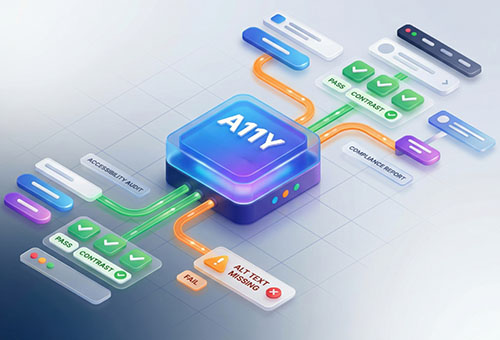
Conversations about accessibility testing often default to a familiar refrain: You can’t just automate, it has to be manual, too. That statement is true, but it’s frequently delivered with an undertone that sells automated testing short, as if it’s a lesser option or a necessary evil. In reality, accessibility testing isn’t an either-or decision; it’s a partnership.
Manual audits are critical for uncovering complex, contextual issues that require human judgment. They’re essential for understanding how real users interact with digital content.
Automated testing brings its own superpower to the table. Automated monitoring excels at catching the everyday problems that creep in during routine updates, content changes, and design tweaks. The issues that are easy to miss but add up quickly.
In a recent blog post, our partner and friends at Equal Entry shared how they discovered firsthand the power of automated testing when an invisible empty link was uncovered during a routine DubBot scan.
One day, DubBot surfaced an issue we wouldn’t have caught through manual reviews alone. A reader left a perfectly standard comment: Thank you, you wrote a great article. Sighted users saw only that sentence. But behind the scenes, the comment included an empty link.
DubBot flagged it because the link had no accessible name. A screen reader would announce it simply as link, offering no context and no purpose. That’s confusing for users and a clear accessibility failure.
Truly sustainable accessibility strategies don’t treat manual and automated testing as an either-or decision. They include both, intentionally. Human-led audits uncover real user barriers that automated tools can miss, while continuous automated testing delivers consistent, continuous insight. Think of manual audits as a deep clean and automated monitoring as routine maintenance.
